Moose Lost in the Woods
Info
- Engine: Unity
- Languages: C#
- Platform: PC, Mac
- Time frame: 2 Months (40 Hours/Week)
- Team Size: 7
Overview
Moose Lost in the Woods was developed during one of my game project courses at Södertörn University. Our assignment was to create a game aimed at a specific target audience.
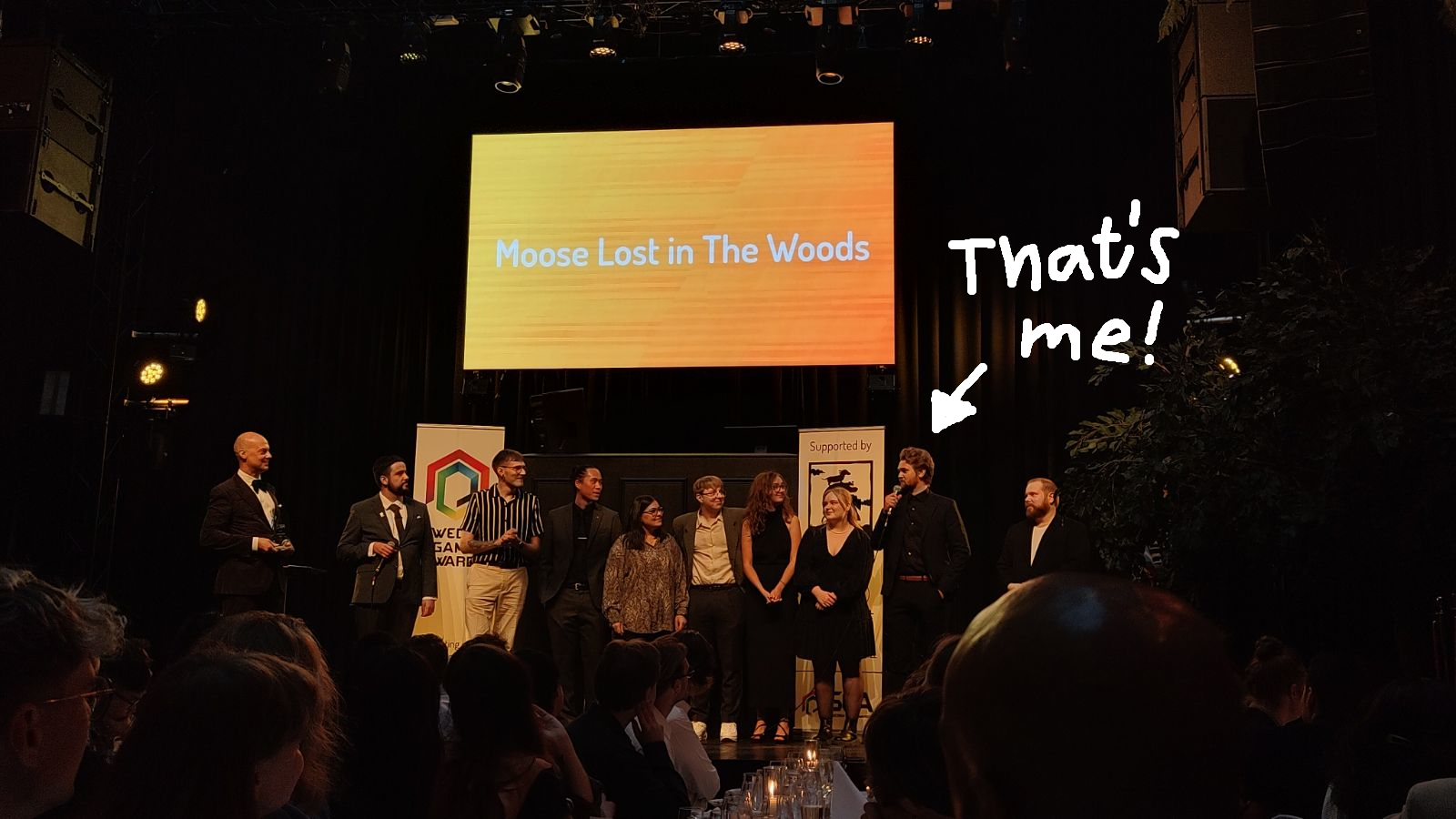
The team and I set out to make a game for children around 6 years old, while also aiming for a spot at the Swedish Game Awards. This ambition resulted in a game that tells a story through illustrative dialogue, a Steam Release, and two awards at the Swedish Game Awards 2023: Best Narrative and Gamers' Choice.
Contributions
- ● 3D platforming character controller with analog input, jump buffering, and coyote time.
- ● Simple camera and camera controls fit for the target audience using Cinemachine.
- ● Automatic camera switching to assist players in landing difficult jumps and framing dialogues.
- ● Save system for saving player progress such as collected items.
- ● Multiple InputActionMaps for menus and In-game controls, with support for multiple controller types (Keyboard, Xbox, DualShock, Nintendo Switch).
- ● Button adaptation system that switches out button icons whenever a new control type is detected.
- ● Controller rumbling and designer-facing rumble pattern editor.
- ● Audio implementation using FMOD with SFX variations, VCAs to control volume for different audio types, and audio buses for effects such as smooth music transitions.
Take aways
One of the main takeaways was learning how to size my scripts and functions. Working with certain scripts became very cumbersome. By the end of the project, I improved greatly in encapsulating functionality and not giving any one script too many responsibilities.
Scope management was also a big takeaway. Even though we had bigger plans for the game, we quickly adapted to our circumstances and became good at prioritizing important functionality over shiny new features.
Designing for a target audience and playtesting were instrumental to the game's development. Many hard decisions were made simple by testing our game on the intended audience. Being able to detach and focus on the product instead of personal preferences helped us immensely and put us in a professional mindset.